
Agspand’s Feedchar® Testimonials
Chicken in trouble
Author: Manuela, Tasmania
A couple of days ago I picked up a sample pack of Agspand’s FEEDCHAR® at a horse event – and just at the right time! One of our chickens had been visibly unwell for a couple of days, hiding in the coop, not eating, and not even wanting to come out for “freerange time”.

Our Dot, back on her feet again.
I made up a slurry of Feedchar for her – and a couple of hours later I saw her pecking at some grass. After some more Feedchar the next day, she is now back to her normal self – bright, hungry and very eager to come out of the coop. I will always make sure to have Agspand’s Feedchar at hand!
Rehab pony’s diarrhoea
Author: Nadine, Naturopath and Rehabilitator, New South Wales
I am an equine nutritionist and naturopath, and my husband Nathan an equine podiotherapist. We run a rehabilitation centre (mostly for laminitis and related issues) on the far south coast of New South Wales.
I have been an advocate for the use of toxin binders for many years but had never used a charcoal-based product. Recently a colleague of ours gave us some sample packs of Agspand’s FEEDCHAR®. There are many remedies I have at my disposal, but I had been waiting for an opportunity to give the Feedchar a good go on something quite obvious.
One of our mares recently went from having normal-looking, well-formed manure to loose(ish) overnight (we suspected it was probably some of the bales in the new load of hay). It was like this for a few days, but not of major concern as often this will right itself, until of course it went to SPLAT! This needed more attention. Being the health nerd that I am, I went inside and grabbed my camera to document before and after photos IF anything occurred.

SPLAT in the morning

Eight hours later
https://www.traditionrolex.com/49
She had the Feedchar for only a couple more days, with no further issues. Okay, so that was interesting, but it could’ve been a coincidence. I still had some sample packs left and I wanted to see if the Feedchar might assist another horse.
A week later a couple of rehab ponies arrived, one with a history of scouring on and off and a very sensitive digestive system. For the first few days she had mostly formed-looking poos (she is about 30 years old). Being in rehab care now, her environment had changed, and her diet was in the process of changing over. She went a little bit loose, so I added some Feedchar with her next couple of feeds. She went from being loose to having beautifully formed little nuggets by the following afternoon!
I had run out of sample packs, though, so thought I’d see how she went. About two days later, she was literally SQUIRTING! Ewww. In my search for the right herbs I found some more Agspand’s Feedchar samples that had fallen down behind some boxes. AWESOME! I had three left and gave these to her over the next few days. She formed up beautifully again. I was really impressed!
Horses and pet dog
Author: Lin, Tasmania

Our Pup, aka Bandit
My name is Lin and I have been using Agspand’s FEEDCHAR® since it first came to Tasmania. I have three horses, but one in particular is prone to laminitis in spring and summer. First I first noticed how quiet and relaxed my thoroughbred became. My pony also responded very well. For my quarter horse, all I can say is that I doubt she would have survived laminitis due to the amount of rain we had leading up to last spring and the amount of grass with mycotoxins if it hadn’t been for Feedchar. I also had a blood test done for suspect Cushings Disease; she is now on medication and has lost a lot of weight.
I have no doubt in my mind that Feedchar may have supported all of my horses in its own way and, with the medication for my quarter horse, I am hoping to get through spring and summer with little or no laminitis in the coming season.
I also have a 38-kilogram dog with a sensitive stomach, especially if I change his diet in some way. I was advised to contact Agspand about my dog. He has had a light sprinkle of Feedchar in his dinner every day for the last week, and I believe it might have assisted with the looseness of his tummy. He has had this problem for nearly 12 years, so I hope he will have less discomfort.
I highly recommend trying Feedchar with any animal with minor behavioural or digestion problems.
Long-term horse feet support
Author: Nina, ACT
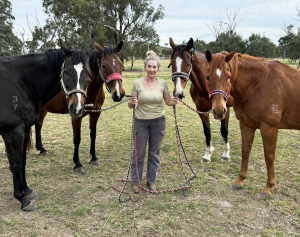
Nina with her horses.
For our sensitive horses in the ACT, we have learned we need to maintain Agspand’s FEEDCHAR® feed-grade minerals-plus-charcoal ongoing.
Greasy Heel — I have one horse that suffers from Greasy Heel very badly. Earlier in the year I was so busy helping with organising comp events that I forgot to re-order when we ran out of Feedchar. My horse developed greasy heel, which turned to cellulitis. He had to have emergency vet care and IV injections for 4 days straight because within 12 hours of developing cellulitis, it turned into blood poisoning!
Long Term Use — My horses have had FEEDCHAR® for more than 6 months now and they are in top health, no tummy conditions, no skin conditions, and NO greasy heel, which is the thing I fear most. Also my Stringhalt Guy is looking great with no indication he is having any issues even though the spring grasses and weeds are coming through.
To support our horses’ long-term health, we are always stocked up with Agspand’s FEEDCHAR.
Goats, horses and dogs
Author: Krystal Rose Miniature Goats, Tasmania
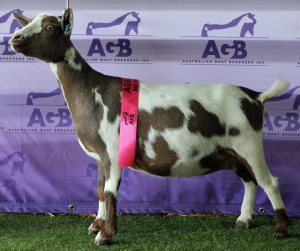
Krystal Rose Pandora ND84.38 on FEEDCHAR®
We are goat breeders and use Agspand’s FEEDCHAR® all year round with our farm animals for different reasons, be it photosensitivity, digestive issues, show prep condition, grass changed, weaning, hay changes or feed changes.
Our miniature goats do amazingly on Feedchar. We mainly use it in their water and it is the first bucket they drink before plain water. It has saved us so many times with sick or diarrhoea-prone kids and adult goats.
We can’t thank Feedchar enough! Feedchar is a “Must Have” in our cupboard. We also use it on the horse and the dogs — the one product we use across our whole 4-legged family!
“Gut Instinct” of horses
Author: Libby Franz, Equine Podiotherapist and Barefoot Trimmer
I am Libby Franz, an equine hoofcare practitioner with a Diploma of Equine Podiotherapy Dip EPT and an Australian Certified Equine Hoofcare Practitioner ACEHP.
My professional work as a barefoot trimmer began in 2005 and since then I have accumulated 20 years’ full-time experience. I have attended many dissection, biomechanics, nutrition and training workshops, and continue my professional development by attending, among other courses, Master Classes with Professor Bowker at The College of Equine Podiotherapy, and working at the dedicated rehabilitation centre “Mayfield” in Victoria.
With this extensive knowledge I established an equine rehabilitation centre in southern Tasmania, where the number of horses and ponies entrusted to my care has increased each season.
What I have learnt and continue to learn through practical experience and research is that a horse’s hoof health is closely aligned to its gut health.
The biggest killer of horses is colic, seconded by laminitis. Laminitis is commonly thought to be a disease of the feet, but it is also related to gut health. High-sugar levels in grasses are usually considered the main cause of laminitis. Fodder with high NSC (non-structural carbohydrate) overloads the hind gut, upsetting the flora and causing the gut to become acidic, which leads to laminitis.
Recently Tasmania experienced successive years of drought. This caused a real shortage of hay, which is the go-to safe feed for horses with any predisposition to laminitic events. Then in spring 2016, the drought broke and heavy rains brought on a surge in growth of all kinds of grasses across the state, noticeably creating an extreme year for laminitis. The rehabilitation centre here was inundated with more cases than I could accept.
During the 2016 spring season, many laminitic horses did improve by coming off a high-sugar diet, but not all. In many instances, even the hay seemed to be a problem. At this time I was introduced to Agspand’s Feedchar®, with the idea it might assist with any mycotoxicity from the endophytes within the pastures and feeds. I was willing to see if the Feedchar as a dietary supplement might support the digestive health of both my own horses and the horses in my care.
I had two ponies who already had been put on a low-sugar diet, but the major indicator of gut health, the manure, was positively toxic. I added Feedchar to their small rations, and initially they sifted out what they could. I also provided a tub of free-choice Feedchar. By the end of three days they were selecting the Feedchar themselves, taking what they needed, when they needed it. One pony who spent the first three days mostly recumbent with a heart rate of over 80 was up and mobile within two weeks, and I believe the Feedchar might have assisted his recovery.
After seeing the gut health of the horses in my care, I introduced a few clients to the product. My observations are supported by feedback from my clients using Feedchar. Interestingly they noticed their horses’ behaviour within a week or two was calm and focused in training.
After continuing to see positive outcomes for horses with improved diets, I believe there is a significant relationship between not only gut health with hoof health, but also with neurological health. I believe it is worthwhile considering the impacts of mycotoxicity in this relationship.
It is important to understand that horses sample feeds and select fodder after feedback from their gut, their gut instinct, if you like. They will select or avoid plants on that basis. Given an environment that provides a wide variety of plants and soils, they will select fodder that meets their health requirements. When climate and intensive farming practice restricts their choice to high-endophyte forage, essentially toxic forage, and our management practices restrict the ability to self-medicate as they would have done through their evolutionary process, I think it is important to consider the impact on their health.
I recommend making Agspand’s FEEDCHAR® available for horses as they need it.
— Libby Franz ©
 Follow us on Facebook
